
5 Tactics for Combating AI and Spotify...
...but only 1 of them is any good.

Spotify may have recently transitioned Daniel Ek out of his role as CEO, but removing the public face of the tech giant has done nothing to change its comic-book-level villainy. Spotify’s many sins are well-documented. (Lizzie No and I cover many of them over on our pod, Y’allidarity Social Club!) Never one to take criticism in good faith, the tech oligarch has continued to stomp out what little good will it has left. Most recently, Spotify updated its terms, demanding artists grant Spotify broad permission to do nearly whatever they want with their art, including using it to train AI models. Additionally, Spotify has announced it will not stop running ICE recruitment ads despite widespread criticism from musicians and users alike.
Unfortunately, the options for fed-up working musicians are limited. For most of us, Spotify is one of our main jobsites, and taking our music off the platform would kill our careers without doing much damage to the mothership. In a tale as old as capitalism, musicians’ options for economic survival are not very different from those who head into work everyday at oligopolistic giants like Amazon or Walmart. Moreover, like workers in many other industries, musicians are being automated out of jobs by bosses who have tracked their labor in order to train their nonhuman replacements. As things currently stand, asking most musicians to move away from Spotify would be like asking a warehouse worker to start their own business because Amazon is evil.
Even though musicians do not enter our workplaces on equal footing with our bosses, we still have means of resisting. Below are four half-baked strategies (for entertainment purposes only), and one, I think, decent start of an idea to counter Spotify and the era of AI slop it is ushering in.
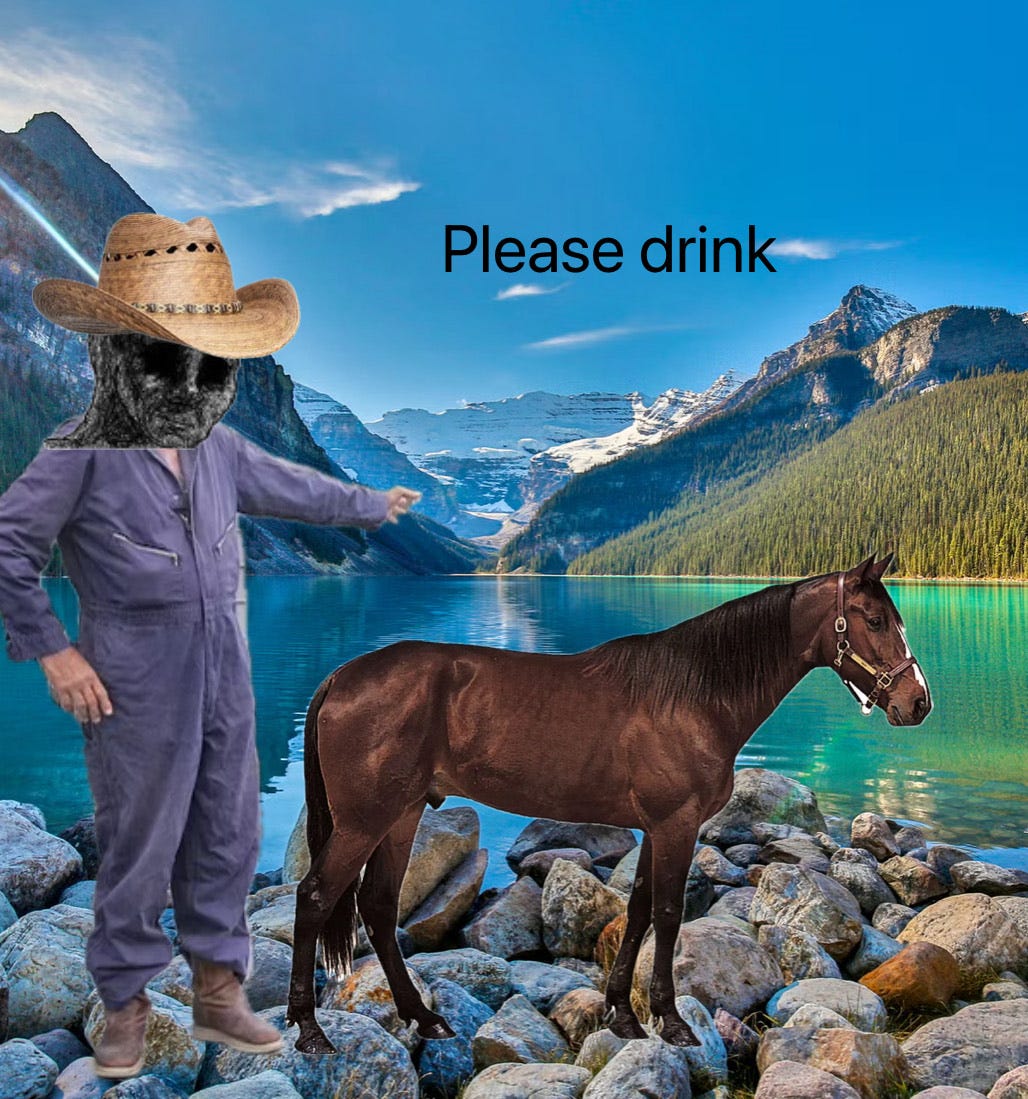
Tactic 1 (half-baked): Guerilla PSA’s. At least once a record, upload a track that functions as an anti-ad reminding people to move to a platform that isn’t demonically alchemizing bisexual sadboi anthems into alt-Swedish SkyNet. Think of it as an anti-landlord jingle you get to sing on the stoop of his ugly green house where he is hosting an eternal, digital porchfest.
Worried about retaliation from Spotify’s robot overlords? Ok, coward. Upload it in reverse and title it “[ listen 2 this song n reverse ].” Real heads will do it with their phones.
Tactic 2 (half-baked): Chaos Offsets. This is the accelerationist, lean-in option. If they want slop, overfill the trough. If they want chaos, give it to them raw.
The steps are simple. Find a ratio of minutes-of-art to hours-of-dissonance that works for you. I think anything above 1:3 is a good start. At that minimum ratio, a 45 minute LP will come with an attendant 135 hours of digital sabotage content. If they want the hot girlfriend (us 💅) to show up to their party, her deadweight, anti-social boyfriend (musical junk) will show up early and leave late.
What is sabotage content? It’s any unpleasant musical thing you unconditionally hate: hours of radio static, cacophonous mashups, irredeemably bad songs, tracks tuned to anything but 440 and 432. Think of this accelerationist option like carbon offsets, planting enough noise trees to cancel out our contributions to the impending AI apocalypse.
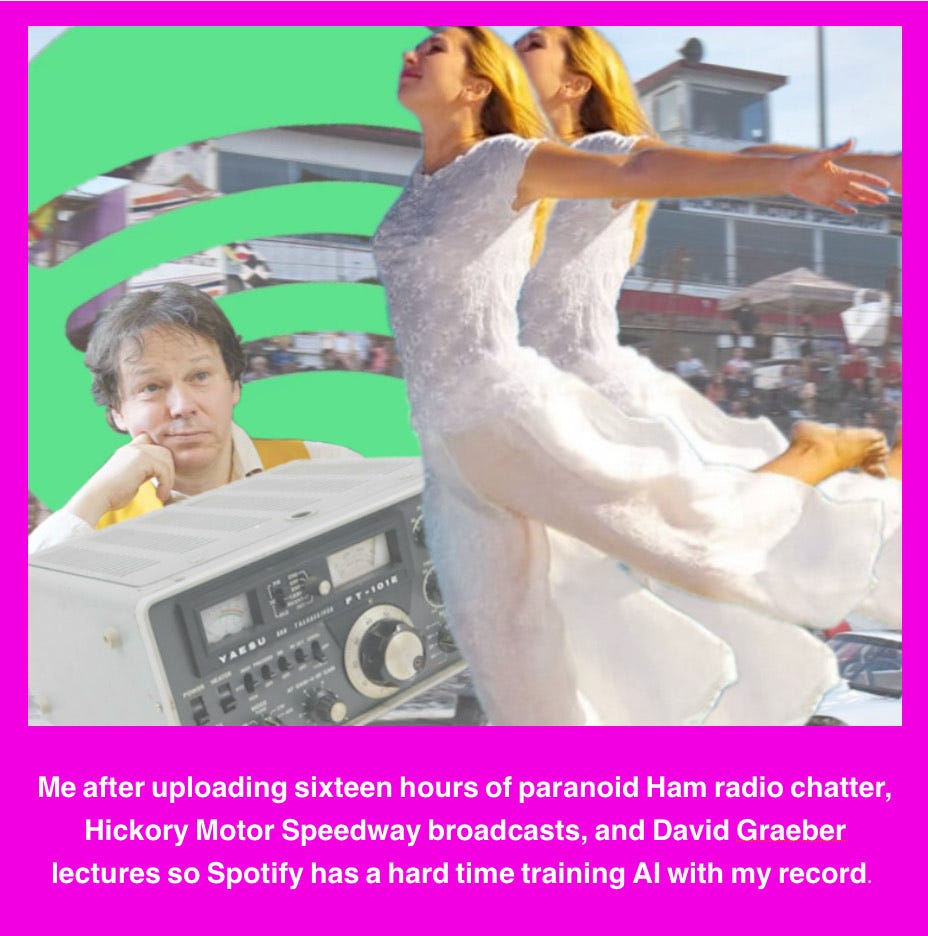
Tactic 3 (half-baked): Theorypostn. The point here is to radicalize the data. Recent news found that the bulk of data used to train AI models comes from Reddit because of the gargantuan amount of information shared on the platform. If AI is producing the average Reddit user—a scary proposition as things currently stand—then we must shift the mean user left. Think of this as the AI equivalent of the Overton window without the liberal cope.
How do we do this? I think we start using every possible opportunity to post David Graeber lectures, reenacted Emma Goldman speeches, and semiotexte audiobooks. By adding these over stock music backgrounds, our theoryposts may have an even better shot at penetrating the musical data set. We can also spam slogans, having entire teams at small labels copy and paste “keep turning left” and “neighborhoods are not barracks for the working class” on music message boards and lyrics aggregators for multiple entire workdays ahead of each single release.
If Spotify is using our songs to generate AI slop, that slop should be besludged with comradely creatine. Plus, if the history of the US government proves anything, the moment something starts talking socialist, the government violently shuts it down. Proletarianizing AI could save humanity from the coming singularity.
Tactic 4 (half-baked): Spotify Message Sabotage. Spotify is encouraging artists to upload a short video to thank their fans as part of this year’s Spotify Wrapped. We might as well use the opportunity to remind listeners of Spotify’s deep-seated nefariousness and encourage them to jump ship. I’m not sure yet exactly how much Spotify will censor the messages artists upload, but if Spotify’s past indicates anything, they will likely continue using their bully platform. Fortunately, artists are creative and can exploit the tech giant’s loopholes and blindspots to circumvent censorship. For example, artists can refer to Spotify as the “green three-browsed monster,” direct folks to a unique destination that encourages them to bail, or thank fans for showing up to your shitty jobsite. If they’re going to give us access to enemy airspace, we have to fly our own flag.
Tactic 5 (still cooking): Musicians’ May Day. The above tactics are half-baked and mostly exist because I have more thoughts than sense. However, despite being conceived in the belly of sleep-deprived, parenthood-induced brain fog,I think the idea of a Musicians’ May Day has some legs.
The notion here is to give free reign over to musicians to compel their audiences to abandon Spotify for other platforms or, more radically, digital media altogether. We select a day, clarify our message—fuck Spotify—and set about honeypotting our audiences into breaking up with our industry’s worst tech overlord. Each artist can choose to focus on any number of issues that resonate with them—investment in the defense industry, running ads for ICE, unconscionable artist pay, bodysnatching songs to feed to the AI vampires, and whatever new horrors Spotify invents between now and the near future.
The best part is musicians know fun, so Musicians’ May Day would be full of the most inviting ways to get people activated. We could release new songs on platforms we like, offer discounts on merch and music sales with proof of Spotify cancellation, or have house shows where the ticket for admission is proof of cancellation or use of accepted platforms. Plus, the pathways opened by Musicians’ May Day could help us organize for participation in a general strike—build solidarity with one another now so we can act in solidarity with others later.
Holler if any of these ideas sound interesting to you or if you’ve got other practices that have been working for you. Would love to hear what folks are coming up with.
The Musicians' May Day concept really resonates with me as a practical approach to collective action. What I find particulary compelling is how it frames resistance not as individual boycotts but as coordinated labor organizing. The idea of using proof of Spotify cancellation as admission to house shows is brilliant - it turns activism into community building. I'm curious about timing though - would May 1st work best given its historical significance, or would another date allow for better coordination? The connection to general strike participation is also intriguing.
The Musicians' May Day concept is genuinely compelling - it combines the collectve power of artists with the creative engagement you mentioned. What strikes me most is your framing of Spotify as a 'jobsite' rather than just a platform; it recontextualizes the power dynamics in a way that makes resistance tactics feel less like individual boycotts and more like labor organizing. The Chaos Offsets idea made me laugh but also think about how artists could use algorithmic pollution as a form of protest. Would be interesting to see what happens if even a small percentage of musicians coordinated on this.